

Did you know that cleaning remains the primary cause of deposit disputes in the UK, appearing in over 56% of all adjudication cases? With the average London rent reaching £2,332 in 2026, a typical five-week security deposit now puts more than £2,690 of your capital at risk. It's exhausting to reach the end of a tenancy only to face the anxiety of potential deductions for minor issues like limescale or dusty extractor fans. You likely feel the weight of the moving process and want a definitive answer on how to pass end of tenancy inspection without the usual stress. We understand that the ambiguity between a domestic clean and an inventory standard often leads to unnecessary friction between tenants and landlords.
This guide will master the exact standards required by inventory clerks to ensure your security deposit is returned in full. We provide a clear, binary checklist of essential tasks and define the precise boundary between fair wear and tear and property neglect. By understanding these technical benchmarks and the latest 2026 London regulations, you can approach your final walkthrough with absolute confidence and professional clarity. You will learn how to document evidence and present a property that meets even the most meticulous inspection criteria.
Key Takeaways
- Differentiate between a standard domestic wipe-down and the technical "inventory standard" required to secure your full deposit return.
- Identify the high-risk "wet rooms" and hidden areas that account for the vast majority of inspection failures in London properties.
- Master the specific criteria for fair wear and tear to avoid being penalised for minor, age-related scuffs and marks.
- Discover how to pass end of tenancy inspection by implementing a rigorous documentation strategy that inventory clerks cannot dispute.
- Learn how to leverage professional standards as a form of "deposit insurance" to mitigate the financial risks of the handover process.
Understanding the 'Inventory Standard': Why Surface Cleaning Fails
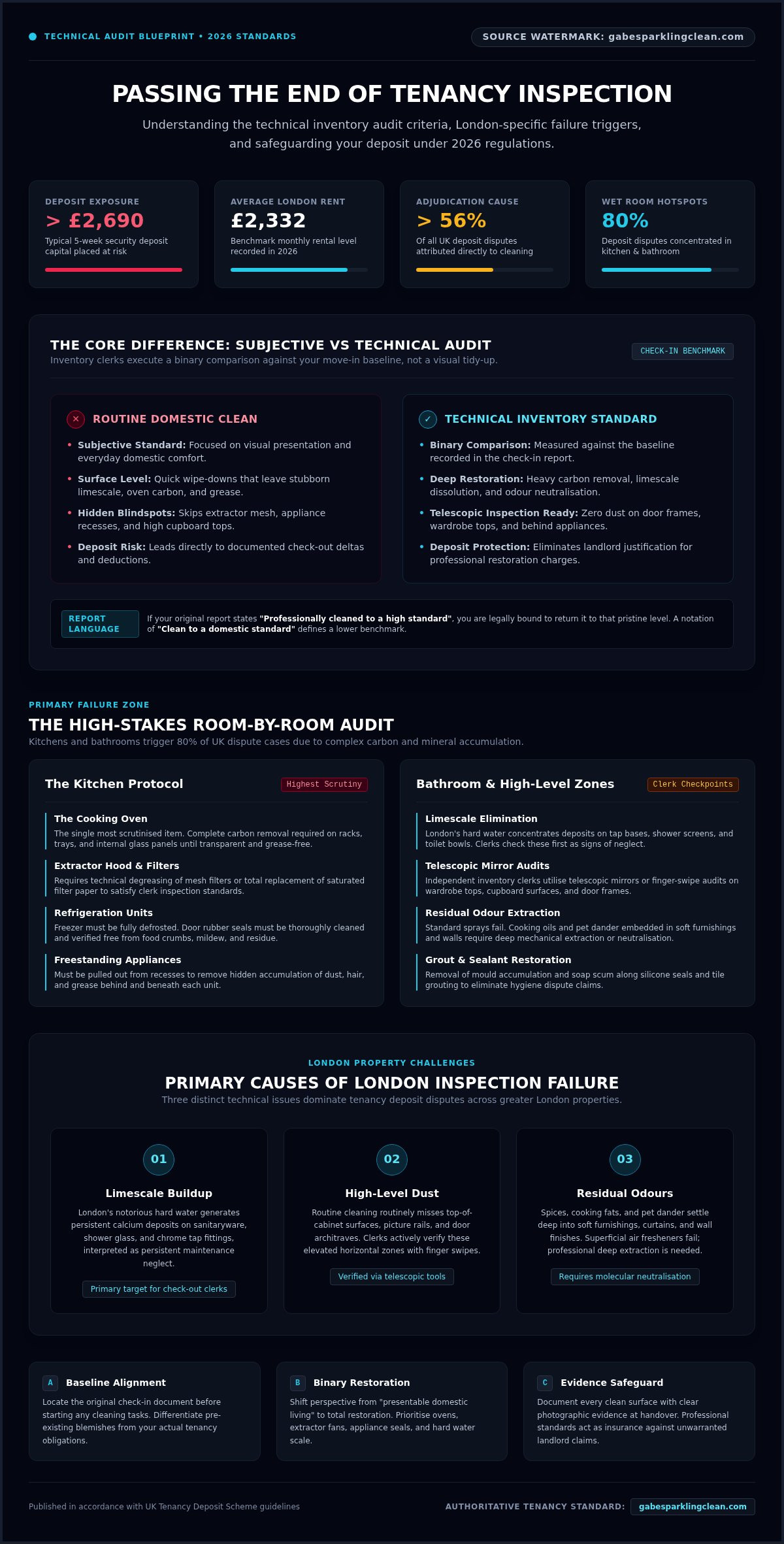
Understanding how to pass end of tenancy inspection begins with recognising that the process is a technical audit, not a subjective opinion. An inspection isn't about making a home look "nice" or "presentable" for the next occupant. Instead, it's a binary comparison between the property's current state and the baseline established in your original check-in report. While a domestic clean might satisfy day-to-day living, it rarely meets the "inventory standard" required by professional agents and landlords.
Independent inventory clerks are trained to look for evidence of restoration rather than simple tidiness. Their scorecard is meticulous, focusing on areas that are often neglected during routine maintenance. Under current tenancy deposit protection legislation, the clerk's report serves as the primary evidence in any dispute. If the clerk notes a delta between the move-in and move-out condition, the landlord has a documented basis for a deduction. This is why surface-level efforts often fail; they don't address the deep-seated grime that accumulates over a long-term tenancy.
The Check-In Report: Your Blueprint for Success
Your original inventory document is the most powerful tool in your arsenal. You must locate this report before you start cleaning to identify pre-existing issues that you aren't responsible for. The vocabulary used in these reports is critical. If your report states the property was "Professionally cleaned to a high standard," you're legally obligated to return it to that same pristine level. Conversely, if it was only "Clean to a domestic standard," the benchmark is lower. Matching the specific terminology used at the start of your tenancy is the most effective way to organise your priorities and protect your deposit.
Common Reasons for Inspection Failure in London
London properties face unique challenges that frequently lead to failed inspections. Statistics from the Tenancy Deposit Scheme (TDS) show that cleaning remains the leading cause of disputes, appearing in up to 56% of cases. In London, three specific issues dominate these failures:
- Limescale buildup: London's hard water leaves stubborn deposits on shower screens, tap bases, and toilet bowls. Clerks check these areas first as they indicate a lack of regular maintenance.
- High-level dust: Surface cleaning often misses the tops of wardrobes, kitchen cupboards, and door frames. A clerk will frequently use a telescopic mirror or a simple finger-swipe to verify these areas.
- Residual odours: Cooking oils and pet dander can permeate soft furnishings and walls. Simple sprays won't suffice; these requires deep extraction or neutralisation to meet professional standards.
Focusing on these technical details ensures you're meeting the agent's expectations rather than just your own. It's about providing a "complete" state of readiness that leaves no room for ambiguity during the final walkthrough.
The High-Stakes Room-by-Room Checklist for 2026
Achieving a full deposit return requires a methodical, room-by-room approach. Understanding how to pass end of tenancy inspection relies heavily on prioritising the "wet rooms"-the kitchen and bathroom-which statistically account for 80% of all deposit disputes in the UK. These areas are subject to the most intense scrutiny because they harbour the most complex grime, such as baked-on carbon and hard-water limescale. Inventory clerks treat these rooms as high-value benchmarks for the overall cleanliness of the property.
Restoration in these spaces goes beyond a standard domestic wipe-down. It involves a "complete" state of readiness where every appliance and surface is returned to its original baseline. If you fail to meet this standard, landlords often justify significant deductions for professional restoration services. Taking a proactive stance on these high-risk areas is the most effective way to protect your capital.
The Kitchen: The Heart of the Inspection
The oven is the single most scrutinised item in any property handover. You must remove all carbon deposits from the racks, trays, and glass panels until they are transparent and grease-free. Similarly, the extractor hood requires technical attention; you should degrease the mesh filters or replace the filter paper entirely. Ensure the freezer is fully defrosted and the rubber seals on the fridge door are free from food debris or mildew. Finally, pull out any freestanding appliances. Dust, hair, and debris accumulate in these hidden voids, and inventory clerks will always check behind the washing machine or fridge to verify a thorough clean.
Bathrooms and Living Areas: Polishing the Details
Limescale is a persistent challenge in London due to the hard water supply. You must eradicate all traces of scale from taps, showerheads, and tile grout whilst ensuring you don't damage the chrome or ceramic finishes. In living areas, focus on the "Hidden Five"-the spots tenants always miss but clerks always check: window tracks, the tops of skirting boards, the centre of light fittings, curtain rails, and the upper edges of door frames. If your carpets or upholstery show deep-seated stains or odours from pets, a standard vacuum won't suffice. These typically require professional extraction to match the "professional clean" status often recorded in initial inventory reports.
External areas must not be overlooked. Balconies, terraces, and external window sills should be cleared of soot, cobwebs, and bird droppings. For a clear understanding of your rights regarding these standards, refer to the GOV.UK guidance on tenancy deposit protection. If the technical demands of this checklist feel overwhelming, commissioning a professional handover clean ensures your property meets the exact benchmarks required by London agencies.
Fair Wear and Tear vs. Damage: Navigating the Grey Areas
Distinguishing between fair wear and tear and actual damage is a critical skill when learning how to pass end of tenancy inspection. Fair wear and tear refers to the natural, gradual deterioration of a property that occurs through normal, everyday use. Under the UK government guidelines on tenancy deposit protection, landlords are prohibited from claiming "betterment." This means they cannot expect a property to be returned in a better condition than when you moved in, nor can they charge for the full replacement of an item that has reached the end of its natural lifespan.
A property presented in a "complete" state of cleanliness often encourages landlords to be more lenient regarding minor marks. When a home is meticulously cleaned, it demonstrates that the tenant has treated the asset with respect. This baseline of care makes it easier to argue that a slight thinning of a carpet or a faint scuff on a skirting board is the result of time rather than neglect. Identifying which issues you can rectify yourself, such as using a magic eraser on wall marks, is essential for protecting your security deposit.
Common 'Grey Area' Examples
Understanding where "wear" ends and "damage" begins requires a logical approach. Consider these common London property scenarios:
- Walls: Minor scuffs near light switches or furniture are typically wear. Large gouges, holes from picture hooks, or unauthorised repainting are considered damage.
- Carpets: Fraying at the edges of a doorway after a five-year tenancy is standard wear. Conversely, red wine stains, cigarette burns, or pet urine odours constitute neglect.
- Stone Worktops: A slight loss of lustre on a granite surface is natural ageing. Deep cracks or ring marks from acidic liquids indicate a failure to provide proper care.
Communicating with Your Landlord Before the Inspection
Proactive communication is your most effective tool for managing expectations. We recommend requesting a "pre-inspection" walkthrough approximately seven days before your move-out date. This allows you to identify potential disputes early and rectify them on your own terms. If you've caused minor damage, disclosing it proactively often leads to a more favourable outcome. Landlords are usually more willing to negotiate a fair repair cost if they don't discover the issue as a surprise during the final audit. Honesty regarding pet behaviour is particularly vital; admitting to a scratched door frame early can prevent the landlord from charging for an entire room's restoration later.
The Handover Day Strategy: Evidence and Documentation
The final handover day is the point where technical preparation meets practical verification. The most critical rule for any tenant is simple: if you didn't photograph it, it didn't happen. Even if you have followed every step on how to pass end of tenancy inspection, your security deposit remains at risk without a robust evidence pack. Inventory clerks are professionals who document facts; you must be prepared to provide counter-evidence that is equally precise and undeniable.
Creating Your Own 'Check-Out' Evidence Pack
To produce "inventory-grade" documentation, use a high-resolution camera and ensure date and time stamps are enabled in the metadata. Wide-angle shots are necessary to establish the overall standard of readiness in each room, but macro shots of high-risk items are what win disputes. You should photograph the inside of the oven, the dishwasher filter, the back of the kitchen cupboards, and the seals of the washing machine. These images prove that you've restored the property to its baseline condition. Additionally, keep all receipts for professional services organised and ready to present. If your move-in report specified a "professional clean," providing a receipt for a professional end-of-tenancy clean is the most efficient way to satisfy that contractual obligation.
The Final Walkthrough: What to Say (and What Not to Say)
We recommend being present during the inspection whenever the agent or clerk permits it. This allows you to defend your work in real-time and clarify any misunderstandings regarding fair wear and tear. Maintain a professional and disciplined attitude whilst the clerk conducts their audit. Carrying a small touch-up kit, including a microfibre cloth and glass cleaner, allows you to rectify minor smudges or dust spots immediately before they are logged. When the check-out report is generated, read it thoroughly before signing. If you disagree with a specific observation, you have the right to add your own comments or provide your time-stamped photos as evidence. This methodical approach ensures the final report is a fair and accurate reflection of the property's state.
Why Professional End of Tenancy Cleaning is the Ultimate Safeguard
Commissioning a professional service is the most effective way to mitigate the financial risk associated with a property handover. In London, where security deposits frequently exceed £2,000, the cost of a specialist clean is a small fraction of the potential loss. Viewing this service as a form of "deposit insurance" allows you to transfer the burden of meeting the inventory standard to experts who understand the technical requirements of letting agents. It's the definitive answer on how to pass end of tenancy inspection without the physical exhaustion of the moving process.
Gabe's Elite Cleaning Ltd provides an inventory-standard deep clean that aligns perfectly with the expectations of the capital's most meticulous agencies. Our approach is disciplined and results-oriented, focusing on the restoration of assets to their baseline state. If your own DIY efforts fail the initial walkthrough, our 24/7 emergency response is available to resolve last-minute inspection panics. This level of accountability ensures you can hand over your keys with the absolute certainty that the property is in an occupancy-ready condition.
The Value of a Professional Receipt
Many London agents prioritise tenants who can provide a professional cleaning invoice because it offers a verified benchmark of quality. This document serves as evidence of your commitment to the tenancy agreement and often simplifies the check-out process. We provide a comprehensive guarantee with our service; if an inventory clerk identifies any missed area, we handle the re-clean at no additional cost. This removes the logistical stress from your schedule, allowing you to reclaim your weekend whilst we manage the heavy lifting and technical restoration.
Specialist Equipment and Solutions
The difference between a domestic wipe-down and a professional handover clean lies in the equipment and chemicals used. We employ industrial-grade steam cleaners that achieve deep carpet restoration, removing pathogens and stains that domestic vacuums cannot reach. Our teams use professional-grade degreasers to eliminate years of kitchen residue hidden amongst the cupboards and extractor systems. These high-level benchmarks are difficult to achieve with supermarket products alone. To ensure your transition is seamless and your capital is protected, book your professional end-of-tenancy deep clean with Gabe's Elite Cleaning.
Securing Your Transition and Protecting Your Capital
Passing a property handover in London requires more than a simple tidy-up; it demands a technical alignment with the original inventory report. You now have the tools to differentiate between fair wear and tear and damage, alongside a methodical strategy for documenting your evidence. By focusing on the high-risk "wet rooms" and the hidden areas often overlooked by tenants, you significantly reduce the likelihood of deposit deductions. Mastering how to pass end of tenancy inspection is ultimately about technical preparation and the removal of subjective ambiguity.
If the logistical burden of deep cleaning feels overwhelming, professional intervention offers the most reliable safeguard. Our team specialises in high-stakes London property transitions, providing inventory-standard deep cleans that are guaranteed to meet agency expectations. We offer a 24/7 emergency response for those facing last-minute inspection panics, ensuring you can move forward with absolute peace of mind. Our expertise ensures your property reaches a complete state of readiness before the clerk arrives.
Secure your deposit with a professional handover clean from Gabe's Elite Cleaning Ltd.
You've worked hard to maintain your home; now ensure you receive the full return you deserve for your next move.
Frequently Asked Questions
Do I have to use a professional cleaning company to get my deposit back?
No, you aren't legally required to hire a professional company. Under the Tenant Fees Act 2019, landlords cannot mandate professional cleaning or force you to provide a receipt. You are only obligated to return the property to the same standard documented in the check-in inventory. However, matching a "professional standard" recorded at the start often requires specialist equipment and industrial-grade solutions to avoid successful deposit disputes.
What happens if I fail my end of tenancy inspection?
If you fail the inspection, the landlord may propose deductions from your security deposit to cover the cost of professional restoration. You have the right to dispute these charges through a government-approved tenancy deposit scheme. To avoid this logistical stress, many London tenants utilise our 24/7 emergency call-outs to rectify identified issues before the final handover report is officially finalised and logged as a failure.
Is the landlord allowed to charge me for professional cleaning if I've already cleaned it?
A landlord can only charge for cleaning if the property's condition has deteriorated since the start of the tenancy, excluding fair wear and tear. If your DIY efforts don't match the "inventory standard" recorded at move-in, they may deduct the cost of a professional restoration. Providing a receipt from Gabe's Elite Cleaning Ltd acts as evidence that you've met the highest technical benchmarks required by agents.
How long does a professional end of tenancy deep clean take?
The duration depends on the property's size and current condition. A studio flat typically takes 3 to 4 hours, whilst a three-bedroom house in London may require 6 to 8 hours of intensive labour. Our teams focus on achieving a "complete" state of readiness, ensuring every appliance, skirting board, and window track meets the meticulous standards expected by professional inventory clerks and property managers.
What is considered 'fair wear and tear' in a London rental property?
Fair wear and tear is the natural deterioration that occurs through normal, everyday use of a property. Examples include minor scuffs on walls near high-traffic areas or a slight thinning of carpet pile over several years. It doesn't cover damage caused by neglect or accidents, such as cigarette burns, deep scratches, or heavy staining, which are considered valid reasons for deposit deductions under 2026 guidelines.
Should I be present during the final inventory check-out?
Yes, we strongly recommend being present during the final walkthrough. This allows you to defend your work and clarify any points of contention regarding how to pass end of tenancy inspection in real-time. If the clerk identifies a minor missed spot, you can often rectify it immediately with a touch-up kit, preventing a formal log of the issue and ensuring a smoother deposit return process.
What are the most common things missed during an end of tenancy clean?
Inventory clerks frequently flag items that are invisible during a standard domestic wipe-down. These commonly include:
- Grease buildup on extractor fan filters and mesh.
- Dust on the upper surfaces of door frames and high wardrobes.
- Limescale on the undersides of taps and showerheads.
- Debris inside the rubber seals of washing machines and dishwashers.
Our meticulous approach ensures these technical details are addressed before the inspection begins.
Can a landlord deduct money for lightbulbs or smoke alarm batteries?
Yes, landlords are entitled to deduct costs if lightbulbs or smoke alarm batteries have failed during your tenancy and aren't replaced before handover. To ensure you understand how to pass end of tenancy inspection fully, you must verify that all electrical fittings are operational. Replacing these minor items yourself is a cost-effective way to prevent landlords from charging premium rates for simple maintenance tasks.


