

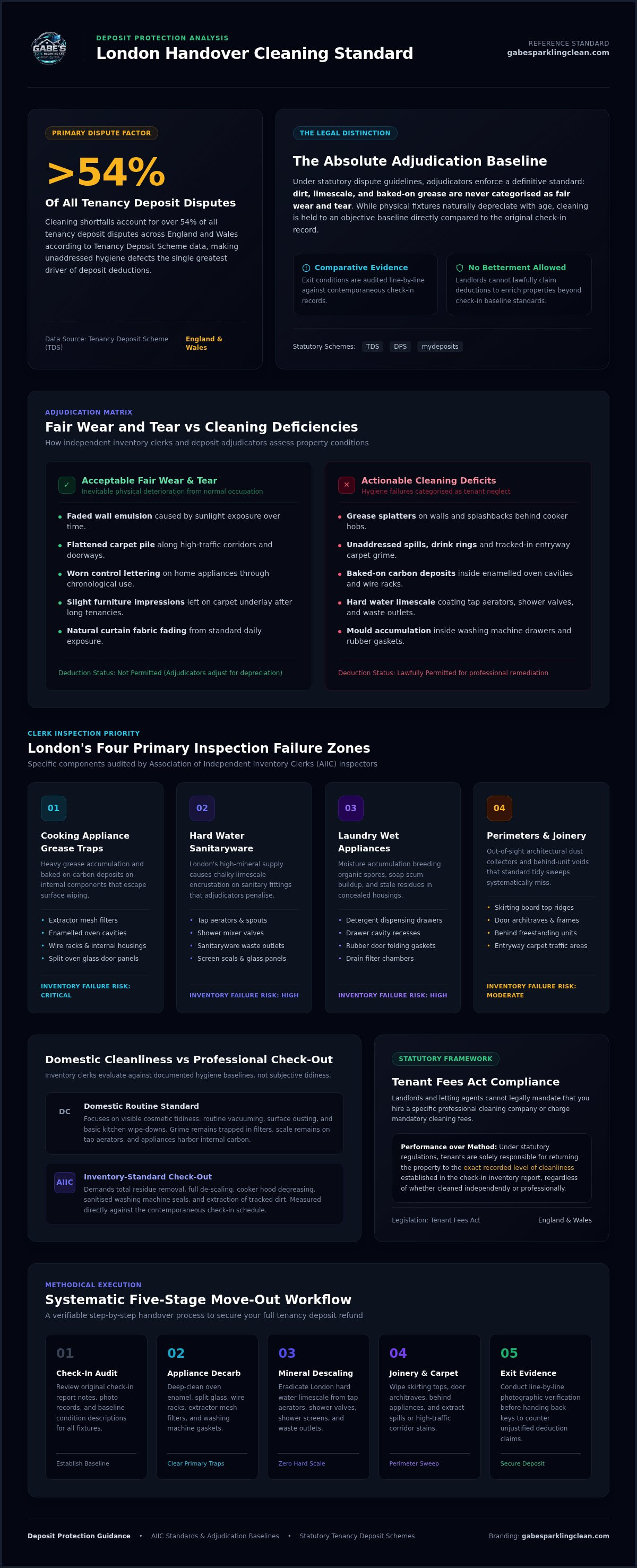
Cleaning accounts for over 54% of all tenancy deposit disputes in England and Wales, according to Tenancy Deposit Scheme data. If you are preparing to hand back your keys, mastering the precise benchmark of cleaning for deposit return London inventory clerks expect is essential. Moving home carries enough pressure without the quiet dread of losing hundreds of pounds over London's hard water limescale, baked-on oven grease, or entryway carpet traffic.
You shouldn't have to endure weeks of delayed funds or stressful dispute resolution simply because the boundary between fair wear and tear and tenant neglect feels subjective. Independent inventory clerks do not evaluate whether a flat looks tidy; they inspect against measurable hygiene baselines compared directly to your check-in report. This comprehensive guide outlines the definitive cleanliness standards required to protect your money, providing a systematic method to audit every room, conquer critical inspection failure zones, and secure your full deposit return without friction.
Key Takeaways
- Understand the precise benchmark of cleaning for deposit return London inventory clerks require, ensuring your property matches original check-in records.
- Learn why adjudicators never consider dirt, limescale, or baked-on grease as fair wear and tear under tenancy dispute guidelines.
- Discover London's four primary inspection failure zones, including hard water scale on sanitaryware and appliance grease traps.
- Clarify your statutory rights under the Tenant Fees Act regarding mandatory cleaning fees versus hygiene performance standards.
- Follow a systematic five-stage move-out workflow that verifies every fixture and fitting to secure your full deposit refund without delays.
What Is Inventory-Standard Cleaning for Deposit Return in London?
Inventory-standard cleaning is the systematic restoration of a rental property to match the precise level of cleanliness recorded on the check-in inventory report. Many tenants assume that leaving a flat tidy ensures a full refund. Yet, cleaning shortfalls remain the single greatest cause of financial friction at the end of a tenancy, driving over half of all dispute claims across England and Wales. When letting agents inspect a handover, they evaluate against recorded baseline conditions rather than general impressions.
Members of the Association of Independent Inventory Clerks (AIIC) inspect properties using strict, objective benchmarks. These professionals do not view a property through the lens of a routine weekend tidy. Instead, they examine whether individual fixtures, appliances, and surfaces have returned to their original documented state, factoring in age and tenancy duration without excusing accumulated grime.
Domestic Cleanliness vs Professional Check-Out Standards
Domestic routines primarily manage visible surfaces through dusting, routine vacuuming, and basic kitchen wipe-downs. In contrast, professional check-out standards require deep sanitisation and total residue removal. When executing thorough cleaning for deposit return London properties demand, inventory clerks focus heavily on neglected zones:
- Degreased cooker extractor mesh filters and internal housings
- Enamelled oven cavities, wire racks, and split glass door panels free from baked-on carbon
- Sanitised washing machine detergent drawers and rubber door gaskets devoid of mould
- De-scaled tap aerators, shower valves, and waste outlets
- Cleaned skirting tops, door architraves, and the recesses behind freestanding appliances
A room might appear immaculate to the naked eye. However, if grease lines the inside of an extractor unit or limescale coats a shower mixer, clerks record these as hygiene defects.
Statutory Deposit Schemes and Objective Evidence
Securing your funds relies entirely on comparative evidence. Under tenancy deposit protection legislation, custodial and insured schemes (such as the TDS, DPS, and mydeposits) require landlords to substantiate any proposed deductions using contemporaneous proof. Adjudicators compare the entry condition line by line against the exit inventory.
If the check-in schedule noted an appliance as "professionally cleaned and grease-free," returning it with grease marks permits a lawful financial deduction. Landlords cannot claim deductions simply because they want a property cleaner than when you received it. Their claims succeed only when the check-out score objectively falls below the initial baseline, making verified, methodical cleaning for deposit return London handovers an indispensable protective measure.
Fair Wear and Tear vs Cleaning Deficiencies: The Adjudication Standard
The distinction between natural material ageing and tenant neglect is often misunderstood. Under government tenancy deposit protection rules, fair wear and tear refers strictly to the inevitable physical deterioration of a property caused by reasonable, everyday occupation. It covers sunlight fading on curtains, thinning carpet pile along high-traffic corridors, or slight furniture pressure marks after a long tenancy.
An absolute legal rule governs deposit arbitration: dirt, grease, and limescale never constitute fair wear and tear. While adjudicators adjust physical fixture replacements for age and natural depreciation, cleaning is held to an absolute baseline. Landlords cannot claim for betterment to enrich a property beyond its documented check-in condition. Unwashed residue, however, gives them immediate grounds to deduct remediation costs. Executing thorough cleaning for deposit return London adjudicators uphold requires treating hygiene as an uncompromising standard.
How Deposit Adjudicators Distinguish Wear from Neglect
Adjudicators weigh tenancy duration, the number of occupants, and baseline check-in notes when reviewing contested deductions. Even so, unhygienic surfaces are universally categorised as tenant neglect rather than physical ageing:
- Faded wall emulsion represents acceptable wear; grease splatters behind a cooker hob represent actionable cleaning deficits.
- Flattened carpet fibres along hallways constitute normal wear; unaddressed spills, drink rings, and tracked-in grime demand professional extraction.
- Worn control lettering on home appliances reflects chronological use; burnt carbon deposits inside an oven cavity remain undisputed cleaning failures.
High-Risk Fixtures Prompting Disputed Claims
Independent inventory clerks routinely target specific fixtures where hygiene standards lapse. Cooker cavities, hob burner rings, and extractor housings produce substantial deduction proposals because baked-on carbon resists basic household detergents. Bathroom sanitaryware presents another primary dispute zone. Hard water crusting around mixer tap bases, shower valves, and waste outlets triggers instant penalty notices from clerks.
Silicone sealants and tile grout lines also face intense scrutiny. Surface condensation that has developed into entrenched black mould requires targeted remediation rather than a casual wipe. Eliminating these liabilities demands structured, deep-level intervention. Booking a specialised end-of-tenancy and handover cleaning team eliminates these risks before an inventory clerk documents actionable deficits on check-out day.
The London Handover Clean: Critical Failure Zones to Address
London inventory clerks follow structured check-out schedules designed to expose hidden hygiene deficits. Passing this audit requires focusing on technical failure points that ordinary domestic routines miss. In the capital, mineral-dense water and compact living environments create concentrated areas of grime that quickly jeopardise your tenancy funds. Understanding official check-out standards outlined in GOV.UK tenancy deposit protection guidance helps tenants target high-liability zones before the formal handover.
Specialised handover cleaning addresses the entire property profile, from light fittings and wardrobe tracks to skirting boards and hidden appliance cavities. When securing your funds is the priority, partnering with Gabe's Elite Cleaning Ltd delivers the methodical, full-scope coverage required to meet strict letting-agent expectations across Greater London.
Kitchen White Goods and Degreasing Protocols
Kitchens generate substantial deduction proposals when greasy residues remain on internal surfaces. Achieving inventory compliance requires methodical dismantling and deep degreasing across all major appliances:
- Split oven door glazing to clean trapped grease runs between the internal panes, whilst soaking wire racks and fan covers.
- Defrost freezers completely, clearing drainage channels and drying internal drawers to prevent stagnant water odour.
- Remove washing machine detergent drawers to scrub black mould, wiping down the internal folds of the rubber door seal.
- Extract metal cooker hood filters to dissolve congealed cooking oils from the mesh and internal motor housing.
London Hard Water, Limescale, and Sanitaryware Remediation
London's water supply contains heavy concentrations of calcium carbonate, typically exceeding 200 parts per million. This hard water leaves chalky mineral crusts that clerks never overlook. Showerheads must be dismantled and soaked in targeted descalers to clear blocked nozzles. Mixer tap plinths require careful acid-based treatment to dissolve crusting without damaging chrome plating. Shower screens must be stripped of etched limescale using specialised compounds, while discoloured silicone caulking and porous grout joints require intensive fungicidal scrubbing.
Living Spaces, Internal Windows, and Carpets
Living zones accumulate ambient London grime, including road pollution and fine dust. Successful cleaning for deposit return London properties require means working methodically from ceiling to floor. Light switches, radiator fins, internal window panes, and glazed tracks must be wiped clean of grey traffic film. Built-in wardrobes require vacuuming into rear corners and shelf joins. Finally, carpets must be vacuumed right up to the baseboards with narrow crevice attachments to eliminate the dark lines of compacted dust that settle along room perimeters.
Self-Cleaning vs Professional Handover Cleaning: Making the Decision
Under the Tenant Fees Act 2019, landlords and letting agents cannot legally compel you to hire a professional contractor or provide a cleaning company receipt. Your statutory obligation is strictly outcome-based: you must return the property to the standard recorded in your original inventory report. This legal freedom leaves moving tenants with a key choice. You can undertake a labour-intensive self-clean, or you can commission specialised property handover specialists.
Equipment, Specialized Chemistry, and Time Constraints
Carrying out a full move-out clean personally requires substantial physical effort and specialised materials. A typical two-bedroom property demands ten to fifteen hours of rigorous scrubbing, usually right when packing exhaustion sets in. Domestic upright vacuums and supermarket sprays rarely match commercial capabilities:
- Standard household degreasers struggle against carbonised oven deposits, whereas professional dip tanks dissolve burnt residue without scratching delicate enamel.
- Off-the-shelf bathroom sprays fail to lift heavy limescale build-up along tap seats without scouring the chrome.
- Domestic vacuum cleaners lack the suction power of industrial hot water extractors, leaving ground-in dirt compacted deep within high-traffic carpet fibres.
Evidentiary Weight of Professional Cleaning Invoices
Independent inventory clerks evaluate physical hygiene impartially, irrespective of who carried out the scrubbing. Even so, an itemised contractor receipt provides persuasive documentary evidence if a landlord later queries property standards. When preparing cleaning for deposit return London tenancies require, relying on DIY efforts carries financial risk; any missed detail allows landlords to commission remedial contractors at your expense.
Investing in specialised End-of-Tenancy & Handover cleaning transfers this logistical burden to vetted professionals equipped with industry-grade tools. If you prefer complete peace of mind during your move, arrange your professional handover service at gabesparklingclean.com to ensure every corner satisfies independent inventory scrutiny.
The Complete London Move-Out Cleaning and Inspection Process
Protecting your tenancy funds requires a disciplined, chronological approach to handing over the keys. Moving out involves severe time pressure, making a five-stage operational sequence vital: complete personal decanting, systematic deep remediation, independent quality auditing, photographic compilation, and the joint inventory walkthrough. Skipping stages or cleaning around half-packed removal boxes creates overlooked corners that derail an otherwise solid effort.
Achieving successful cleaning for deposit return London landlords and letting agents accept means eliminating subjective disputes before they begin. Following a structured procedure ensures your property meets formal check-out specifications across every square metre.
Pre-Inspection Audit Against Original Check-In Records
Begin by comparing each room directly against your initial move-in schedule. Check-in inventories often document pre-existing defects, such as historic carpet marks, minor paint chips, or legacy appliance stains. Identifying these notes prevents you from scrubbing surfaces that were already marked at the start of your tenancy:
- Confirm that all personal belongings, rubbish bags, and unused food items are completely cleared from cupboards and loft spaces.
- Cross-reference noted appliance blemishes with current conditions, rectifying any new grime that appeared during your stay.
- Check that all furniture items listed in furnished inventories are returned to their designated original positions.
Compiling Contemporaneous Visual Evidence
Once remediation is complete, capture comprehensive, date-stamped photographic and video evidence. Document internal oven linings, extractor filter mesh, sanitaryware, window sills, and skirting boards in bright daylight or under strong artificial lighting. Record a continuous, high-resolution video sweep showing functioning, spotless white goods and clean cupboard interiors. Keep these files securely backed up until your tenancy deposit scheme confirms the final release of all funds.
Managing Check-Out Walkthroughs and Inquiries
Always attend the official check-out inspection alongside the appointed inventory clerk if scheduling allows. Accompanying the specialist lets you clarify baseline discrepancies on the spot, demonstrating where documented flaws pre-dated your tenancy. If the clerk notes minor surface dust settling after your clean, presenting an itemised service receipt immediately establishes that the property underwent comprehensive remediation.
Partnering with Gabe's Elite Cleaning Ltd ensures your flat satisfies rigorous check-out criteria the first time, delivering the professional documentation and standard of cleaning for deposit return London renters need for a swift, complete payout.
Take Control of Your Tenancy Handover and Secure Your Deposit
Navigating the end of a tenancy requires precision rather than guesswork. Protecting your money comes down to three clear rules: dirt and limescale are never excused as fair wear and tear, surfaces must match the baseline documented in your check-in schedule, and contemporaneous visual proof prevents arbitrary deduction claims.
Achieving the rigorous standard of cleaning for deposit return London letting agents demand requires methodical execution. Gabe's Elite Cleaning Ltd provides comprehensive property handovers across London residential locations, deploying experienced cleaning operatives equipped with commercial-grade cleaning technology. Our specialised protocols are engineered specifically to satisfy strict inventory standards, neutralising disputed claims before they can delay your refund.
Don't let move-out exhaustion compromise your hard-earned tenancy funds. Secure your full deposit return with Gabe's Elite Cleaning Ltd and transition to your new home with complete confidence.
Frequently Asked Questions
Can a London landlord force me to use a specific professional cleaning company?
No. Under the Tenant Fees Act 2019, landlords and letting agents cannot legally require you to hire a nominated contractor or pay for a check-out cleaning fee. These are prohibited payments. Your sole legal requirement is to return the property to the standard recorded in your original check-in inventory report, allowing for normal fair wear and tear.
What happens if the property is cleaner at check-out than noted on my check-in inventory?
You are not entitled to compensation, but your landlord cannot claim any cleaning deductions. Statutory adjudication schemes strictly prohibit "betterment", which prevents landlords from using tenant funds to upgrade a property beyond its original baseline. If your check-in report noted dusty sills or greasy filters, returning them spotless easily protects your money against deduction claims.
How clean does an oven really need to be for a full deposit return?
An oven must be completely free of burnt carbon, grease residue, and food debris across all surfaces. Independent inventory clerks examine internal enamel linings, side wire racks, trays, fan covers, and the glass door sandwich. Standard surface wipes don't suffice. Achieving the level of cleaning for deposit return London clerks demand requires full immersion degreasing and meticulous carbon removal.
Is limescale build-up considered fair wear and tear under London tenancy rules?
No, deposit adjudicators treat limescale accumulation as tenant neglect rather than fair wear and tear. While London water is exceptionally hard, limescale is classified as removable mineral grime. Leaving crusting on tap spouts, shower valves, toilet waste bends, or shower screens provides landlords with legitimate grounds to claim chemical descaling costs directly against your deposit funds.
What should I do if my landlord proposes unfair cleaning deductions from my deposit?
Challenge the proposal in writing immediately and request evidence, including dated check-out photos and itemised contractor receipts. Compare their claims line by line against your original check-in documentation and exit photographs. If you cannot reach an agreement, raise a formal dispute through your government-authorised protection scheme (TDS, DPS, or mydeposits) for impartial adjudication.
Can carpet cleaning deductions be made if carpets were stained before my tenancy?
No, provided those specific stains were clearly noted on your check-in inventory or confirmed in dated move-in photos. Landlords can only deduct costs for new marks or dirt accumulated during your occupancy. If a dispute arises, adjudicators assess photographic evidence to establish whether current conditions match the initial report, protecting tenants from legacy floor marks.
How soon after vacating my London property must my deposit be returned?
Under statutory scheme rules, landlords must return undisputed deposit amounts within 10 calendar days once both parties reach an explicit, mutual agreement on deductions. This timeline does not begin on your physical move-out day if discussions remain ongoing. If deductions are contested, any undisputed portion must still be released while the remaining balance undergoes independent dispute resolution.


