

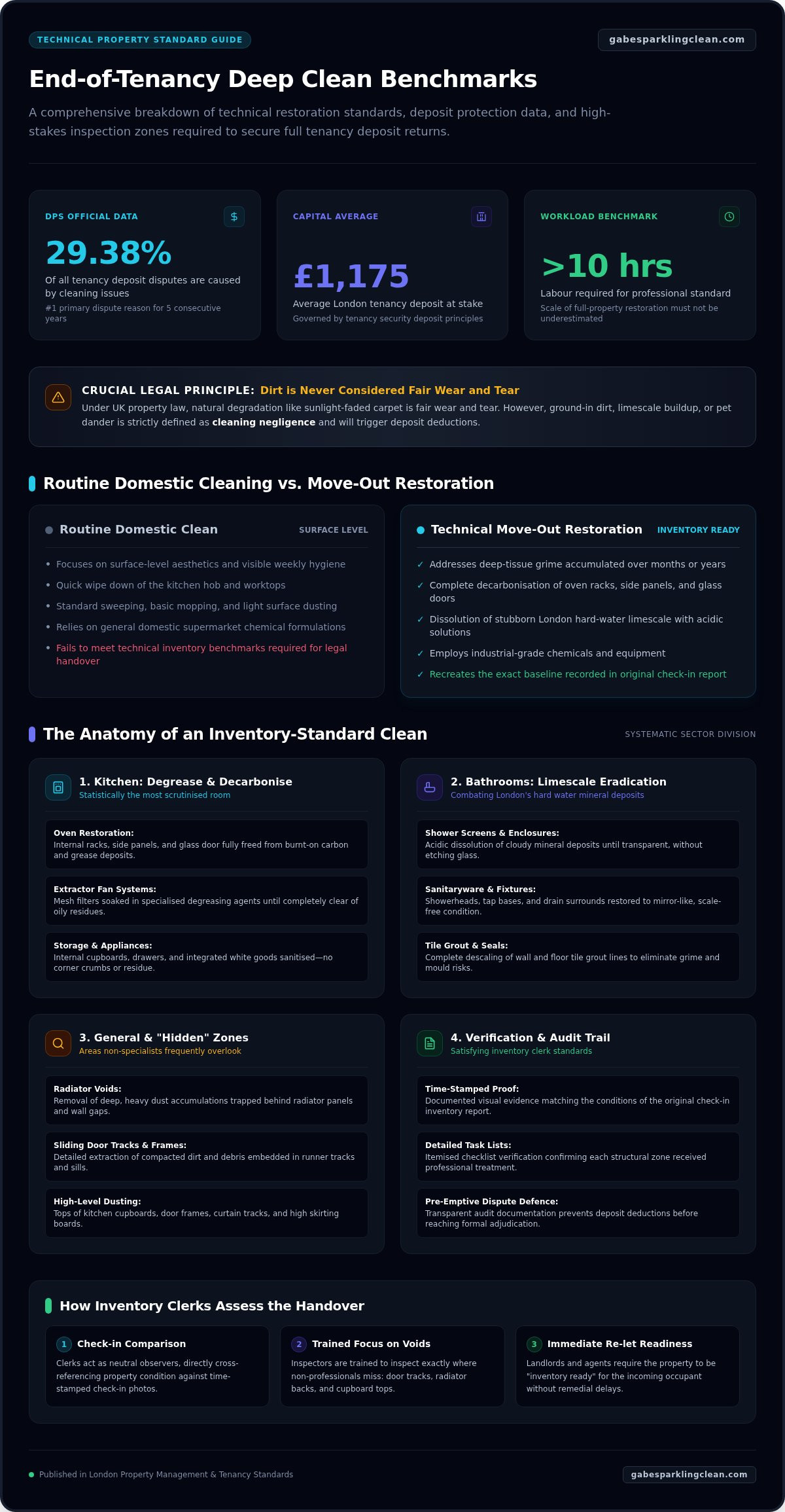
Did you know that cleaning issues are responsible for 29.38% of all tenancy deposit disputes? According to recent data from the Deposit Protection Service, failing to meet inventory standards remains the primary reason tenants lose their money for the fifth consecutive year. Executing a comprehensive deep clean before moving out is not merely a domestic chore; it's a technical restoration to a precise, professional baseline.
You likely feel the immense pressure of managing a London relocation whilst worrying that a minor oversight, like a dusty skirting board or a limescale-filmed showerhead, could lead to a costly deduction. It's overwhelming to face a full property clean when you're already exhausted by the logistics of moving and confused by the "professional standards" mentioned in your contract.
This article provides the expert benchmarks you need to restore your property to the exact standard required to secure your deposit return. We'll examine the high-stakes areas that adjudicators scrutinise most, from carbonised oven grease to appliance seals, giving you the clarity and peace of mind needed for a seamless transition to your new home.
Key Takeaways
- Understand that a move-out clean is a technical restoration to a specific baseline, not a simple domestic tidy-up.
- Master the systematic approach required for a deep clean before moving out to ensure every hidden zone meets inventory standards.
- Identify the high-stakes areas like carbonised oven grease and bathroom limescale that most frequently cause deposit deductions.
- Realise that a professional-standard clean often requires over 10 man-hours, so don't underestimate the scale of the task.
- Learn how to leverage professional verification and disciplined cleaning protocols to eliminate the stress of London property handovers.
Understanding the Deep Clean Before Moving Out
Returning a London property to its original state is a technical requirement, not a subjective preference. A professional deep clean before moving out is a systematic process designed to restore every surface to the exact condition documented in the initial check-in report. In the competitive London rental market, where the average tenancy deposit stands at £1,175, the financial stakes of a failed handover are high. Landlords and agents expect the property to be "inventory ready" for the next occupant immediately. This level of readiness is governed by tenancy security deposit principles, which dictate that the property must be returned to its professional baseline, minus fair wear and tear.
Restoration vs. Routine Cleaning
Routine cleaning focuses on visible hygiene and surface-level aesthetics. Restoration, however, addresses the deep-tissue grime that accumulates over months or years. Whilst a weekly domestic clean might involve a quick wipe of the hob, a move-out restoration requires the removal of carbonised grease from oven interiors and extractor filters. In London's hard water areas, removing stubborn limescale from shower screens and tap bases is essential. These precise interventions protect the landlord's assets and ensure that fixtures don't require premature replacement due to neglect. A standard domestic tidy-up simply cannot reach the technical benchmarks required for a legal handover.
The Role of the Inventory Clerk
An inventory clerk acts as a neutral observer who compares the property's current state against the time-stamped photographic evidence from the start of the tenancy. They look for specific indicators of professional maintenance. It's vital to understand the distinction between fair wear and tear and cleaning negligence. A faded carpet from sunlight is wear; a carpet with ground-in dirt or pet dander is a cleaning failure. Dirt is never considered wear and tear under UK property law. Providing professional evidence of a deep clean before moving out, such as a detailed task list or verification from a specialist, creates a transparent audit trail. This documentation often prevents disputes before they reach formal adjudication, ensuring a smoother transition for all parties involved.
- Kitchen: Degreasing of all internal appliances and cupboards.
- Bathrooms: Complete descaling of sanitaryware and tile grout.
- General Areas: Dusting of high-level surfaces, including door frames and curtain tracks.
- Evidence: Time-stamped proof of work to satisfy clerk inspections.
The Anatomy of an Inventory-Standard Clean
A successful handover requires more than a cursory sweep. It demands a zone-by-zone restoration that mirrors the meticulousness of a professional inventory clerk. To achieve this, you must adopt a systematic approach that divides the property into logical sectors: Kitchen, Bathroom, Living Areas, and Exteriors. A true deep clean before moving out isn't just about effort; it's about using industrial-grade chemicals and equipment to achieve results that domestic products cannot replicate. This level of precision ensures that the property meets the stringent requirements outlined in government tenancy deposit protection regulations.
A professional standard focuses heavily on "hidden" zones that non-specialists frequently overlook. These include the tops of kitchen cupboards, the internal tracks of sliding doors, and the dust-heavy voids behind radiators. Neglecting these areas is a common reason for failed inspections, as clerks are trained to check exactly where most people forget to clean. By following a disciplined checklist, you ensure every square inch of the property is returned to its baseline state.
The Kitchen: Degreasing and Decarbonising
The kitchen is statistically the most scrutinised room in any London property. To pass, the oven must be completely decarbonised. This means the internal racks, side panels, and glass door must be free from any burnt-on carbon or grease. Extractor fans require similar attention; filters must be soaked in degreasing agents until they are clear of oily residue. It's also essential to sanitise the interiors of all cupboards, drawers, and integrated appliances. Even a small accumulation of crumbs in a corner can trigger a deduction.
Bathrooms and Wet Rooms: The Limescale Challenge
London's hard water makes limescale the primary antagonist in bathroom restoration. Showerheads, taps, and glass screens must be descaled until they are transparent and free from cloudy deposits. This requires specialised acidic solutions that dissolve mineral buildup without etching the underlying surfaces. You must also ensure that tile grout and silicone sealants are free from black mould or soap scum. Achieving this "white-standard" finish is a hallmark of a meticulous property handover that protects your financial interests.
Professional vs. DIY: The Real Cost of a Failed Inspection
Tenants often view the move-out process as a simple logistics exercise. They frequently underestimate the technical precision required for a deep clean before moving out. A thorough restoration of a standard two-bedroom London property typically demands between 10 and 20 man-hours of intensive labour. Attempting this alone whilst managing a relocation creates significant physical and mental strain. If a DIY effort fails to meet the clerk's benchmark, landlords often exercise their right to hire their own contractors. These "re-clean" fees are typically deducted directly from the deposit and are often significantly higher than the cost of a pre-emptive professional service.
Evidence is the most critical factor in deposit disputes. A professional certificate of completion acts as a formal defence against subjective claims of poor hygiene. Following Shelter's guidance on deposit deductions for cleaning, it's clear that adjudicators value documented proof of professional intervention. This verification provides a layer of protection that a supermarket receipt for bleach simply cannot match. It establishes a clear baseline of quality that is difficult for a landlord to contest during the final checkout.
Equipment and Chemical Efficacy
Industrial results require industrial tools. Domestic vacuum cleaners often lack the suction power to remove embedded allergens or construction dust from deep within carpet fibres. Professional teams utilise HEPA-filter extraction units and specialised pH-neutral solutions. These chemicals are designed to be effective against stubborn grime without causing the chemical burns or discolouration often associated with harsh supermarket bleach. For London properties with difficult access, specialised reach-and-wash systems are essential for external window cleaning. These professional tools ensure a streak-free finish that satisfies even the most meticulous inventory clerk on the first visit.
The Value of Time and Peace of Mind
The opportunity cost of a DIY clean is substantial. Spending a final weekend scrubbing an empty property is a significant burden when you could be settling into your new home. Professional cleaning functions as an insurance policy for your security deposit. It removes the logistical risk, especially with the availability of 24/7 emergency response for last-minute handover crises. This systematic approach ensures the property is ready for inspection on the first attempt, facilitating a clean financial break from your old tenancy. You gain the freedom to focus on your move whilst experts handle the technical restoration of the property.
Critical Areas That Determine Deposit Returns
Focusing your efforts on high-stakes zones is the most efficient way to protect your financial interests. In London, three primary areas consistently trigger the majority of cleaning-related deposit deductions: the kitchen, the bathrooms, and the floorcoverings. Whilst previous sections addressed the technical restoration of appliances, a successful deep clean before moving out also requires a "sparkle" finish on often-forgotten fixtures. This involves removing every fingerprint from light switches, wiping the tops of door frames, and ensuring lightbulb fittings are free from dust. These small details signal to an inventory clerk that the property has been maintained to a professional standard throughout.
Floorcare: Beyond the Vacuum
Standard domestic vacuuming is rarely enough to satisfy an inventory clerk's inspection. Carpets often require hot water extraction to remove deeply embedded urban dust, allergens, and lingering odours that domestic machines cannot reach. This is especially true for tenancies involving pets, where dander accumulation can lead to significant deductions if not addressed with professional-grade equipment. Hard floors must be restored to a uniform, debris-free finish without the sticky residue often left by supermarket detergents. If your flooring shows signs of heavy traffic or stubborn staining, you can book a professional end-of-tenancy clean to ensure these surfaces meet the required occupancy-ready baseline.
Windows and External Surfaces
London's urban environment leads to a rapid build-up of soot and pollution on external glass and frames. Streak-free windows are vital for enhancing the property's "kerb appeal" and significantly influence the clerk's overall perception of hygiene. If the windows are obscured by city grime, it often leads to a more rigorous inspection of the interior. Using purified water systems ensures a crystal-clear finish that allows maximum natural light into the property. For those with balconies or patios, addressing external grime is an essential value-add. Whilst pressure washing is a highly effective method for restoring these surfaces, ensuring they are at least swept and free from organic growth is a baseline requirement to complete a thorough deep clean before moving out.
Securing Your Handover with Gabe's Elite Cleaning Ltd
Gabe's Elite Cleaning Ltd operates as a specialised partner for tenants and property managers across London. We understand that a high-stakes move requires more than a general tidy-up. Our service is a disciplined intervention designed to meet the rigorous benchmarks of independent inventory clerks. By delegating the technical burden of a deep clean before moving out to our team, you ensure a professional restoration that protects your financial assets. We focus on the precision and thoroughness required to remove the logistical stress from your relocation.
Our 24/7 emergency response provides an essential safety net for last-minute relocation crises. We offer a level of reliability that matches the fast-paced nature of the London property market. Whether you're vacating a studio in SE14 or a multi-bedroom house in Greater London, our goal is to provide absolute peace of mind through precision and accountability. We don't just clean; we restore your property to a complete state of readiness for the next occupant.
Our Systematic Approach to Property Restoration
We follow a methodical, ceiling-to-floor flow to ensure no surface is overlooked. This structured process mirrors the organised nature of an inventory inspection, moving logically from specific needs to concrete outcomes. Our teams focus on verification, providing the evidence of work required to satisfy landlord scrutiny on the first attempt. This systematic approach transforms a deep clean before moving out from an overwhelming task into a verified professional result. Our process includes:
- Dusting and sanitisation of high-level fixtures, vents, and door frames.
- Degreasing and technical restoration of all internal kitchen appliances.
- Complete descaling of bathroom sanitaryware to a professional white-standard finish.
- Industrial-grade floorcare using HEPA-filter extraction for dust and allergens.
Our SafeContractor accredited standards mean every intervention is executed with meticulousness and safety. We use professional-grade equipment specifically designed to handle construction dust, urban soot, and heavy limescale. This commitment to high-level benchmarks ensures that your property meets the "Elite" standard every time.
Booking Your Move-Out Clean in London
Securing our services is a straightforward process designed for clarity and ease of navigation. We provide transparent, professional quotes based on the specific requirements of your property and its inventory history. Our teams are available for both scheduled handovers and urgent, last-minute requests. We take full responsibility for the final result, allowing you to focus entirely on your transition to a new home without the fear of financial disputes. You can rely on our authoritative expertise to handle the complexities of your move-out requirements.
Organise your elite move-out clean today to secure your deposit return with confidence.
Secure Your Deposit with Professional Restoration
Navigating a London property handover requires a disciplined approach to cleanliness that meets precise inventory benchmarks. A deep clean before moving out is a technical restoration of your home's baseline state, focusing on the high-stakes areas that inventory clerks scrutinise most. By addressing carbonised grease, urban soot, and hard-water limescale with industrial-grade equipment, you remove the risk of costly deposit deductions. This methodical focus ensures the property is returned in a complete state of readiness for the next occupant.
Gabe’s Elite Cleaning Ltd acts as your specialist partner in this transition. As SafeContractor accredited London handover experts, we provide the meticulous verification and 24/7 emergency response needed for a seamless move. Choosing professional restoration isn't just about a spotless finish; it's about the peace of mind that comes from a job executed to an elite standard. Delegate the logistical burden of cleaning to a team that takes full accountability for your results.
Request a Professional Move-Out Cleaning Quote and ensure your transition to a new home is both smooth and financially secure. You've worked hard to maintain your property; let us help you protect the value of your deposit.
Frequently Asked Questions
Does a move-out deep clean guarantee the return of my deposit?
A professional clean significantly reduces the risk of deductions for hygiene but cannot guarantee a full deposit return. Adjudicators consider other factors, such as property damage, rent arrears, and unauthorised redecorating. However, providing a professional certificate for your deep clean before moving out proves you fulfilled your contractual cleaning obligations. This documentation acts as a vital defence during the inventory checkout process and helps prevent subjective disputes with landlords.
How long does a professional deep clean take for a two-bedroom flat in London?
A thorough restoration of a two-bedroom property typically requires between 10 and 15 man-hours to reach an inventory-ready state. The exact duration depends on factors like the level of limescale buildup and the condition of kitchen appliances. Our teams work systematically to ensure every surface, from extractor filters to skirting boards, meets professional benchmarks. This comprehensive approach ensures the property is ready for inspection on the first attempt without requiring time-consuming re-cleans.
Do I need to be present whilst the professional cleaners are working?
You don't need to be present whilst our specialist teams are working. Most clients in London prefer to arrange key collection through a concierge, letting agent, or a secure lockbox. This allows you to focus on the logistics of your move whilst we handle the technical restoration of the property. Once the work is complete, we provide verification of the results, ensuring the property is fully prepared for the final inventory clerk inspection.
What is the difference between end-of-tenancy cleaning and a standard deep clean?
End-of-tenancy cleaning is a technical restoration specifically designed to meet the baseline recorded in an initial inventory report. Unlike a standard deep clean, it includes the internal sanitisation of all appliances, cupboards, and drawers. We also focus on high-stakes areas like carbonised oven grease and bathroom limescale that clerks scrutinise. This service is a definitive solution for tenants who need to restore their property to a professional standard before a legal handover.
Are cleaning materials and equipment included in the service price?
Yes, all professional-grade chemicals and industrial equipment are included in our service. We utilise high-performance tools, such as HEPA-filter extraction units and specialised descaling agents, that aren't available in supermarkets. These industrial solutions are essential for removing stubborn urban soot and mineral deposits without damaging delicate surfaces. Our teams arrive fully equipped to execute the "Elite" standard of cleaning, ensuring a comprehensive restoration that meets the most stringent property benchmarks.
Can you provide emergency cleaning if my move-out date has changed suddenly?
We provide a 24/7 emergency call-out service to accommodate sudden changes in move-out dates or last-minute handover requirements. Our London-based teams are prepared to respond rapidly to urgent situations, ensuring your property is restored to inventory standards even on a tight schedule. This round-the-clock availability offers essential peace of mind during the often unpredictable relocation process. We take full responsibility for the outcome, providing a reliable partner when you face high-stakes timing constraints.
What happens if the inventory clerk is not satisfied with the cleaning?
If an inventory clerk identifies specific areas that don't meet the required standard, we offer a dedicated re-clean response. We focus on providing evidence of work and verification to satisfy the inspector's requirements. Our systematic approach and use of detailed checklists usually prevent these issues from arising. However, our commitment to accountability means we'll address any legitimate cleaning oversights promptly to ensure your transition to a new home remains smooth and financially secure.
Do you clean external areas like balconies and windows as part of the service?
External window cleaning is a core part of our service portfolio, as streak-free glass is vital for property kerb appeal. We also tidy balconies and patios to ensure they are free from debris and organic growth. Whilst we are currently expanding our capabilities to include professional pressure washing, we presently focus on restoring these external surfaces to a neat, inventory-ready state. These interventions ensure the entire property, including its outdoor spaces, meets a consistent professional baseline.


